[Case 02]
Health Tech


Breathe: A Mobile App to Reduce and Quit Vaping
Designing a behavior-change experience for young adults using real-time health feedback.
Project Overview
Youth and young adults have the highest prevalence of e-cigarette use, with over a quarter of current users vaping daily. Despite serious neurological, respiratory, and cardiovascular risks, vaping is widely perceived as a “safer” alternative and remains highly habitual.
Key challenges we identified:
Vaping is automatic and hard to notice in the moment
Health consequences feel distant and abstract
Existing tools lack real-time, personalized feedback
This created a gap between behavior and awareness that made quitting extremely difficult.
Problem Statement
How might we help young adults become aware of their automatic vaping habits and support them with timely, personalized interventions that make behavior change sustainable?

[Industry]
Health Tech
[My Role]
UX Designer & Researcher
[Platforms]
mobile
[Timeline]
4 weeks
4 weeks
Persona

Maya Williams
College junior
Maya started vaping in her first year of college as a social activity with friends. Over time, it became a daily habit she barely notices anymore. She vapes while studying, walking between classes, and when she feels stressed. Although she knows vaping is harmful, the long-term health risks feel distant and abstract.
She has tried to quit twice using generic quit apps, but stopped using them after a few days because the feedback felt vague and unmotivating.
21
MI
High Tech
Female
Goals
Goals
Reduce daily vaping and eventually quit
Understand how vaping is affecting her health now, not years from now
Replace vaping with healthier coping strategies
Fustrations
Fustrations
Vapes automatically without realizing how often
Finds cravings hardest to manage during stress and social situations
Existing quit tools feel generic and disconnected from her real behavior
Design Goal
Design an intervention that helps users:
• Become aware of their real vaping patterns • Interrupt automatic habits in the moment • Stay motivated through visible, meaningful progress
We focused on three principles:
• Make behavior visible through real-time data • Reduce cognitive load during cravings • Support long-term behavior change, not just tracking
Design an intervention that helps users:
• Become aware of their real vaping patterns • Interrupt automatic habits in the moment • Stay motivated through visible, meaningful progress
We focused on three principles:
• Make behavior visible through real-time data • Reduce cognitive load during cravings • Support long-term behavior change, not just tracking
Design an intervention that helps users:
• Become aware of their real vaping patterns • Interrupt automatic habits in the moment • Stay motivated through visible, meaningful progress
We focused on three principles:
• Make behavior visible through real-time data • Reduce cognitive load during cravings • Support long-term behavior change, not just tracking


Solution Overview
Breathe is a mobile app paired with a vape attachment and wearables that tracks:
1. Puff count and pickups 2. Time and location of use 3. Heart rate and respiratory metrics
The app translates this data into: • Personalized health insights • Adaptive goals • Real-time feedback • Quick alternatives during cravings This allowed us to combine self-monitoring, goal setting, and just-in-time interventions in one cohesive experience.
Solution Overview
Breathe is a mobile app paired with a vape attachment and wearables that tracks:
1. Puff count and pickups 2. Time and location of use 3. Heart rate and respiratory metrics
The app translates this data into: • Personalized health insights • Adaptive goals • Real-time feedback • Quick alternatives during cravings This allowed us to combine self-monitoring, goal setting, and just-in-time interventions in one cohesive experience.
Solution Overview
Breathe is a mobile app paired with a vape attachment and wearables that tracks:
1. Puff count and pickups 2. Time and location of use 3. Heart rate and respiratory metrics
The app translates this data into: • Personalized health insights • Adaptive goals • Real-time feedback • Quick alternatives during cravings This allowed us to combine self-monitoring, goal setting, and just-in-time interventions in one cohesive experience.
[Click image to make larger and click image again to zoom out]
[Click image to make larger and click image again to zoom out]
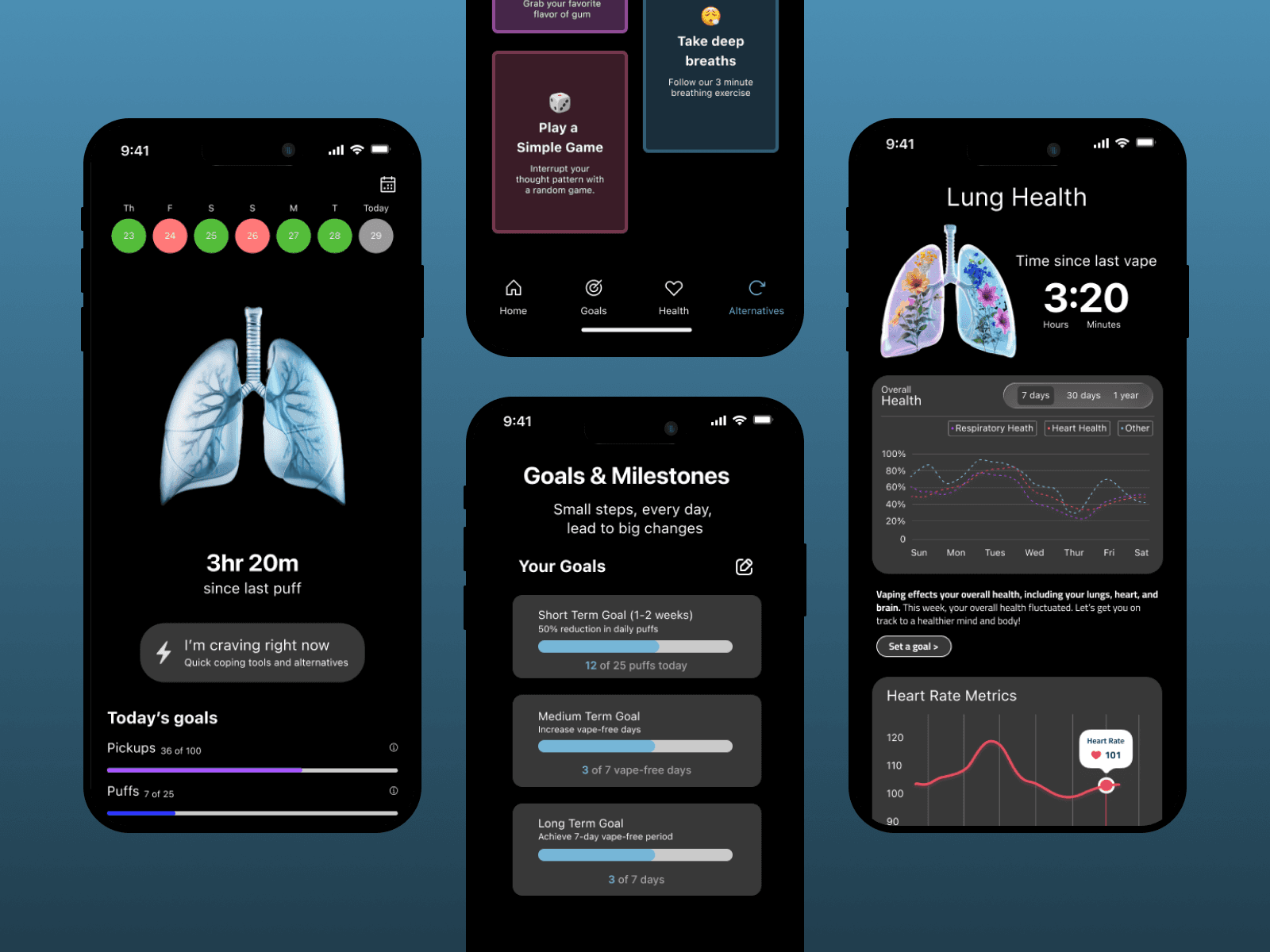
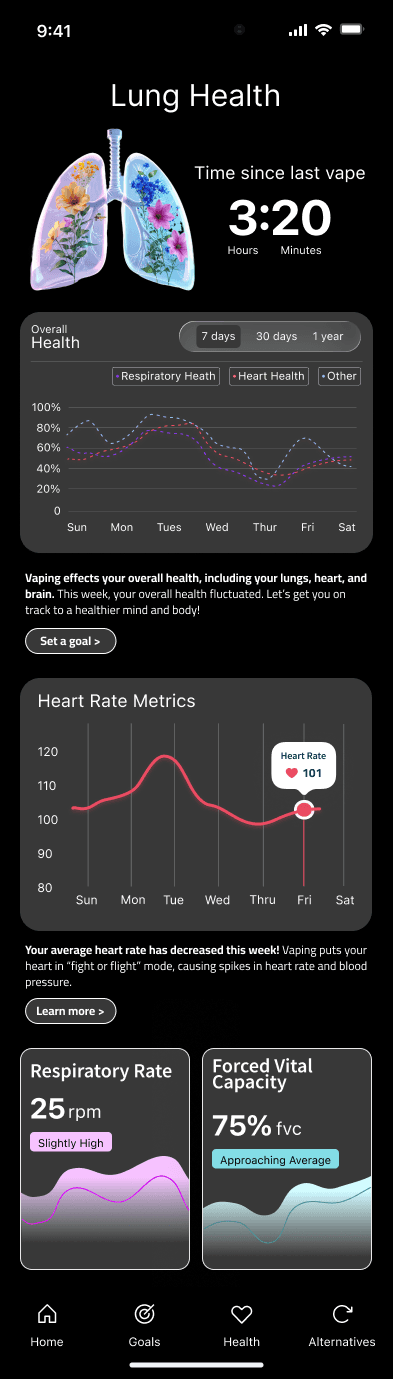
1. Real-Time Health Insights
Users see live metrics like: • Time since last puff • Heart rate trends • Lung capacity indicators
Each metric is paired with simple explanations so users understand what it means for their body, not just the number.
Why this matters: Seeing immediate physiological feedback helps connect daily choices to real health outcomes.
1. Real-Time Health Insights
Users see live metrics like: • Time since last puff • Heart rate trends • Lung capacity indicators
Each metric is paired with simple explanations so users understand what it means for their body, not just the number.
Why this matters: Seeing immediate physiological feedback helps connect daily choices to real health outcomes.
1. Real-Time Health Insights
Users see live metrics like: • Time since last puff • Heart rate trends • Lung capacity indicators
Each metric is paired with simple explanations so users understand what it means for their body, not just the number.
Why this matters: Seeing immediate physiological feedback helps connect daily choices to real health outcomes.

Got rid of confusing transaction home screen and made a dedicated home screen
Design Process
[Design Process]
2. Dynamic Lung Visualization
We designed a central lung graphic that: • Grows flowers as behavior improves • Becomes frosted when usage increases
We tested multiple concepts and chose a glassmorphism lung that balanced: • Approachability • Emotional impact • Non-judgmental feedback
This avoided shaming while still communicating severity.
2. Dynamic Lung Visualization
We designed a central lung graphic that: • Grows flowers as behavior improves • Becomes frosted when usage increases
We tested multiple concepts and chose a glassmorphism lung that balanced: • Approachability • Emotional impact • Non-judgmental feedback
This avoided shaming while still communicating severity.
2. Dynamic Lung Visualization
We designed a central lung graphic that: • Grows flowers as behavior improves • Becomes frosted when usage increases
We tested multiple concepts and chose a glassmorphism lung that balanced: • Approachability • Emotional impact • Non-judgmental feedback
This avoided shaming while still communicating severity.
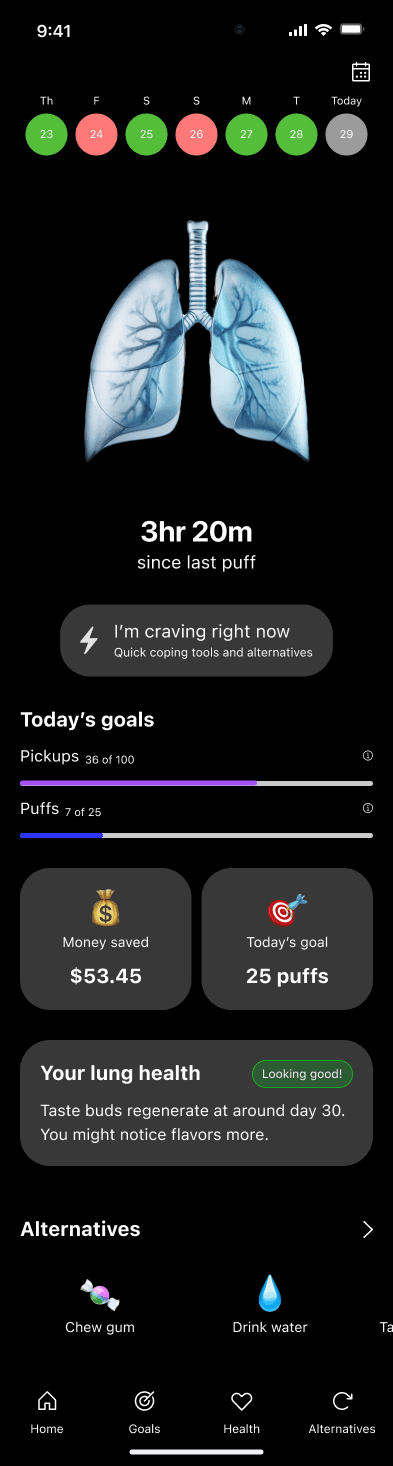
3. Usage Dashboard
A daily snapshot shows:
• Puffs taken • Pickups • Money saved • Progress toward goals
This avoided shaming while still communicating severity.
3. Usage Dashboard
A daily snapshot shows:
• Puffs taken • Pickups • Money saved • Progress toward goals
This avoided shaming while still communicating severity.
3. Usage Dashboard
A daily snapshot shows:
• Puffs taken • Pickups • Money saved • Progress toward goals
This avoided shaming while still communicating severity.

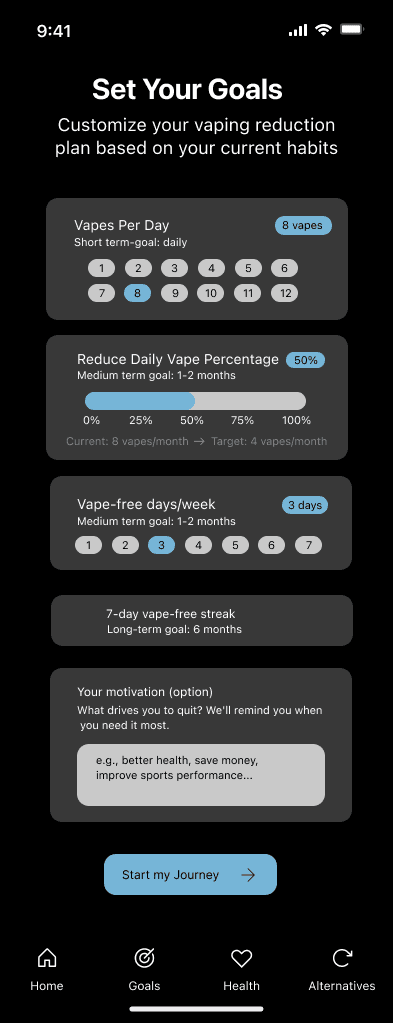
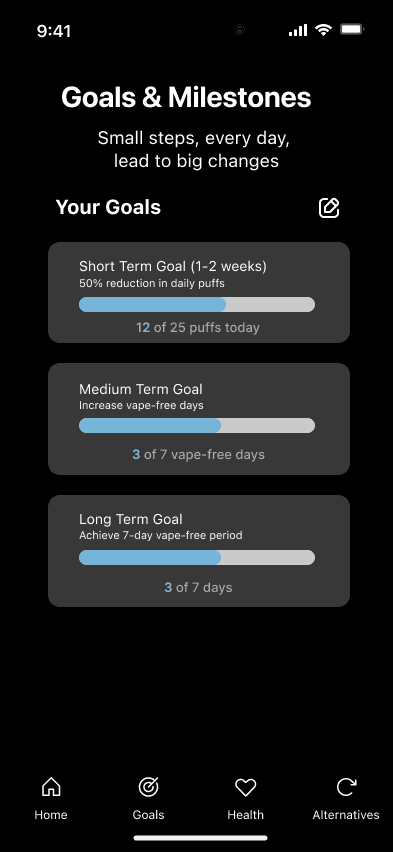
4. Goal Setting System
We designed a tiered goal system: • Short-term goals for quick wins • Medium-term goals for momentum • Long-term goals for commitment
Goals auto-populate based on onboarding and adapt as behavior changes.
Design intent: Reduce decision fatigue while preserving user autonomy.
4. Goal Setting System
We designed a tiered goal system: • Short-term goals for quick wins • Medium-term goals for momentum • Long-term goals for commitment
Goals auto-populate based on onboarding and adapt as behavior changes.
Design intent: Reduce decision fatigue while preserving user autonomy.
4. Goal Setting System
We designed a tiered goal system: • Short-term goals for quick wins • Medium-term goals for momentum • Long-term goals for commitment
Goals auto-populate based on onboarding and adapt as behavior changes.
Design intent: Reduce decision fatigue while preserving user autonomy.



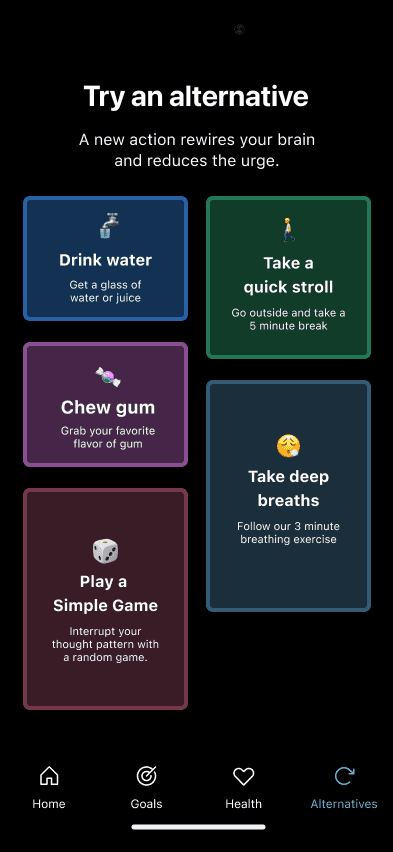
5. Vape Alternatives
When cravings hit, users can instantly access low-effort alternatives such as:
• Breathing exercises • Physical movement • Distraction activities
These are designed for speed and simplicity when willpower is lowest.
5. Vape Alternatives
When cravings hit, users can instantly access low-effort alternatives such as:
• Breathing exercises • Physical movement • Distraction activities
These are designed for speed and simplicity when willpower is lowest.
5. Vape Alternatives
When cravings hit, users can instantly access low-effort alternatives such as:
• Breathing exercises • Physical movement • Distraction activities
These are designed for speed and simplicity when willpower is lowest.

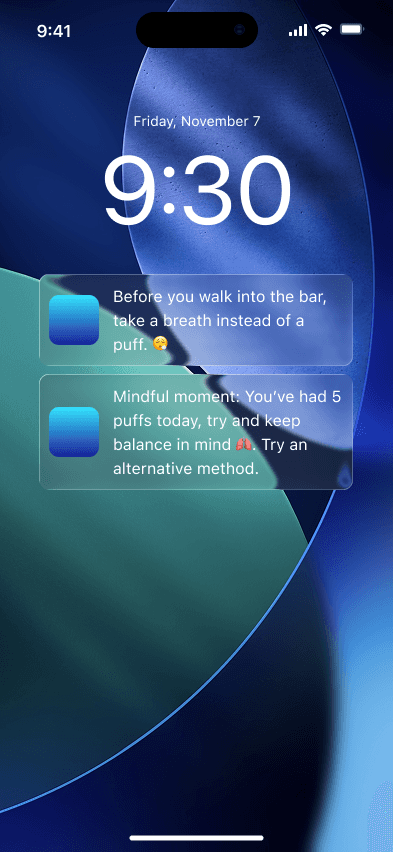
6. Smart Notifications & Performance Indicators
The app sends timely, context-aware notifications based on usage patterns, time of day, and health signals. Notifications prompt users to pause, reflect, try an alternative, or review a relevant health insight. A lock-screen widget shows real-time puff counts and progress toward daily goals.
Design intent:
Interrupt automatic habits at the right moment, reduce notification fatigue through relevance, and guide users directly to meaningful actions.

6. Smart Notifications & Performance Indicators
The app sends timely, context-aware notifications based on usage patterns, time of day, and health signals. Notifications prompt users to pause, reflect, try an alternative, or review a relevant health insight. A lock-screen widget shows real-time puff counts and progress toward daily goals.
Design intent:
Interrupt automatic habits at the right moment, reduce notification fatigue through relevance, and guide users directly to meaningful actions.
6. Smart Notifications & Performance Indicators
The app sends timely, context-aware notifications based on usage patterns, time of day, and health signals. Notifications prompt users to pause, reflect, try an alternative, or review a relevant health insight. A lock-screen widget shows real-time puff counts and progress toward daily goals.
Design intent:
Interrupt automatic habits at the right moment, reduce notification fatigue through relevance, and guide users directly to meaningful actions.



Behavior-Change Strategy
We grounded the design in:
• Self-regulation theory through continuous feedback • Self-determination theory through autonomy and competence • Goal-setting theory through progressive milestones
Interrupt automatic habits at the right moment, reduce notification fatigue through relevance, and guide users directly to meaningful actions.
We grounded the design in:
• Self-regulation theory through continuous feedback • Self-determination theory through autonomy and competence • Goal-setting theory through progressive milestones
Interrupt automatic habits at the right moment, reduce notification fatigue through relevance, and guide users directly to meaningful actions.
We grounded the design in:
• Self-regulation theory through continuous feedback • Self-determination theory through autonomy and competence • Goal-setting theory through progressive milestones
Interrupt automatic habits at the right moment, reduce notification fatigue through relevance, and guide users directly to meaningful actions.
Behavior-Change Strategy
Because this was a course prototype:
• The vape attachment was conceptual only • Notification logic was not behavior-triggered • Adaptive interventions were not technically implemented
This helped clarify feasibility constraints and future engineering needs.
Because this was a course prototype:
• The vape attachment was conceptual only • Notification logic was not behavior-triggered • Adaptive interventions were not technically implemented
This helped clarify feasibility constraints and future engineering needs.
Because this was a course prototype:
• The vape attachment was conceptual only • Notification logic was not behavior-triggered • Adaptive interventions were not technically implemented
This helped clarify feasibility constraints and future engineering needs.
High Fidelity Prototype
Outcomes
Outcomes
Increased Awareness of Automatic Habits
In-the-Moment Support During Cravings
Sustained Motivation for Long-Term Change
Key Learnings
Key Learnings
Behavior Change Requires Systems, Not Features
Designing for habit change taught me that no single feature drives impact. Real progress comes from orchestrating data, feedback, goals, and interventions into a cohesive system that supports users over time.
Behavior Change Requires Systems, Not Features
Designing for habit change taught me that no single feature drives impact. Real progress comes from orchestrating data, feedback, goals, and interventions into a cohesive system that supports users over time.
Behavior Change Requires Systems, Not Features
Designing for habit change taught me that no single feature drives impact. Real progress comes from orchestrating data, feedback, goals, and interventions into a cohesive system that supports users over time.
Timely Feedback Matters More Than Perfect Information
I learned that in-the-moment, relevant feedback is more effective than detailed long-term insights. Intervening at the right moment with simple guidance can interrupt habits more effectively than complex dashboards alone.
Timely Feedback Matters More Than Perfect Information
I learned that in-the-moment, relevant feedback is more effective than detailed long-term insights. Intervening at the right moment with simple guidance can interrupt habits more effectively than complex dashboards alone.
Timely Feedback Matters More Than Perfect Information
I learned that in-the-moment, relevant feedback is more effective than detailed long-term insights. Intervening at the right moment with simple guidance can interrupt habits more effectively than complex dashboards alone.
Motivation Is Built Through Progress, Not Pressure
This project showed me that sustainable change comes from reinforcing small wins and autonomy rather than using fear or guilt. Designing non-judgmental, motivating feedback was critical to keeping users engaged.
Motivation Is Built Through Progress, Not Pressure
This project showed me that sustainable change comes from reinforcing small wins and autonomy rather than using fear or guilt. Designing non-judgmental, motivating feedback was critical to keeping users engaged.
Motivation Is Built Through Progress, Not Pressure
This project showed me that sustainable change comes from reinforcing small wins and autonomy rather than using fear or guilt. Designing non-judgmental, motivating feedback was critical to keeping users engaged.